Simpson Manufacturing Co. (SSD)·Q4 2025 Earnings Summary
Simpson Manufacturing Q4 2025 Earnings: Double Beat, Stock Near 52-Week High
February 9, 2026 · by Fintool AI Agent
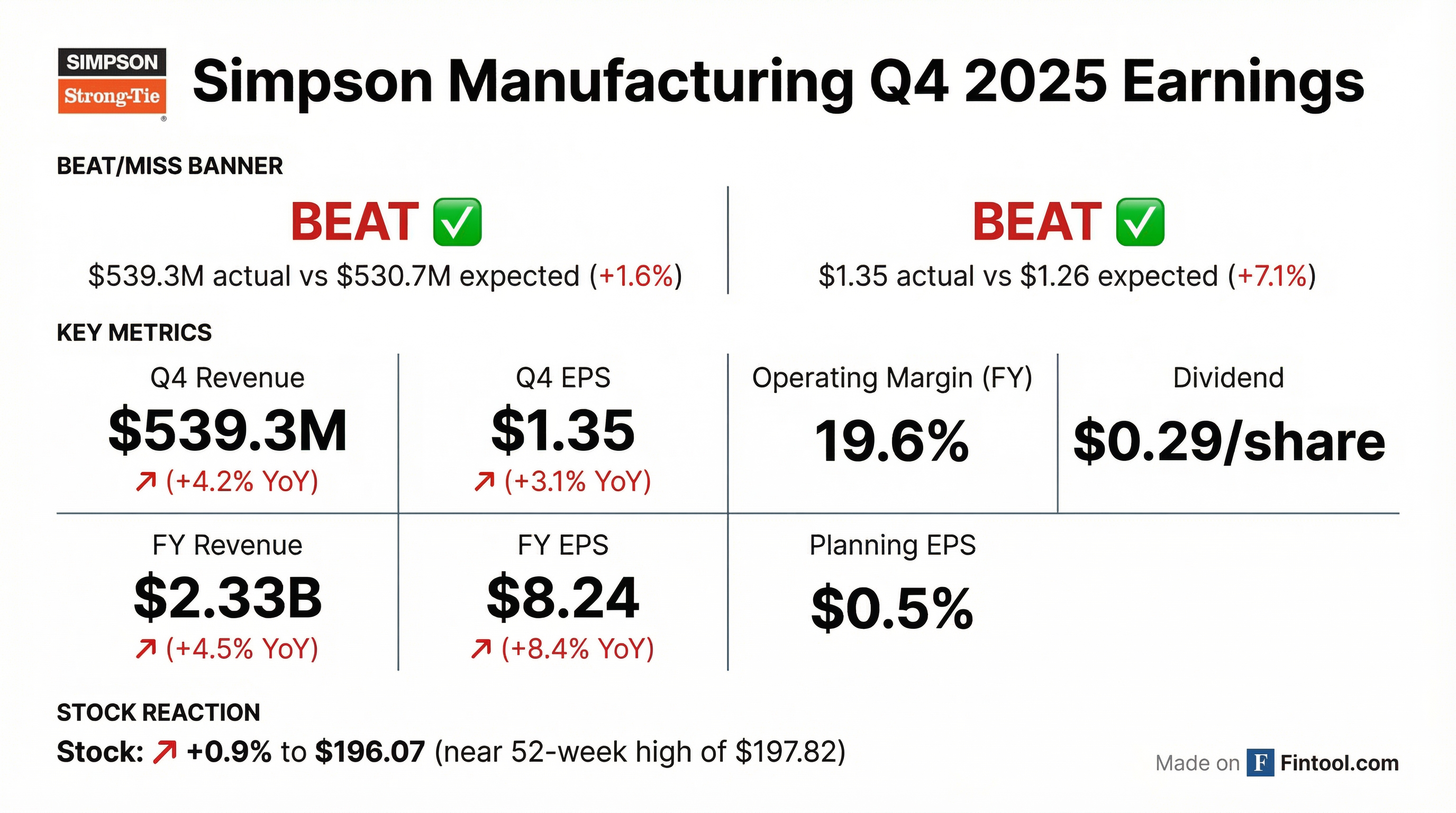
Simpson Manufacturing (SSD) delivered another double beat in Q4 2025, extending its streak of earnings outperformance to five consecutive quarters. The structural connector maker posted revenue of $539.3M (+1.6% vs consensus) and EPS of $1.35 (+7.1% vs consensus), demonstrating pricing power and operational resilience despite a persistently flat U.S. housing market.
Did Simpson Manufacturing Beat Earnings?
Yes — both revenue and EPS exceeded expectations:
Simpson has now beaten EPS estimates in 5 consecutive quarters:
For the full year, Simpson delivered strong results in a challenging market:
 Ask Fintool AI Agent
How Did the Stock React?
Simpson shares rose +0.9% to $196.07 following the earnings release, trading just below the 52-week high of $197.82. The muted reaction suggests the beat was largely expected given the company's consistent outperformance.
Key stock metrics:
- Current price: $196.07 (+0.9%)
- 52-week range: $137.35 - $197.82
- Market cap: ~$8.1B
- Year-to-date: +21.4% from Dec 31, 2025 close of $161.47
What Drove the Q4 Results?
CEO Mike Olosky highlighted the company's disciplined execution, noting two key milestones:
Safety record: For the second consecutive year, Simpson achieved a total recordable incident rate of less than 1.0 — the best result in company history — with meaningful reductions in lost-time injuries and incident severity.
70th anniversary: 2026 marks 70 years since Bark Simpson founded the company in 1956, starting with a single joist hanger and building into a global portfolio of structural connector solutions.
Revenue bridge for Q4 2025 (+4.2% YoY):
- Price increases: +5.6%
- Foreign exchange: +1.8%
- Volume: -4.0% (housing market headwinds)
- Other adjustments: +0.8%
Full year revenue bridge (+4.5% YoY):
- Price increases: +2.7%
- Acquisitions (Monet DeSauw): +0.9%
- Volume: -0.9%
- Foreign exchange: +0.8%
- Other: +1.0%
The company continues to demonstrate above-market volume growth relative to U.S. housing starts — averaging ~3 percentage points above the market.
Segment Performance: Europe Shines
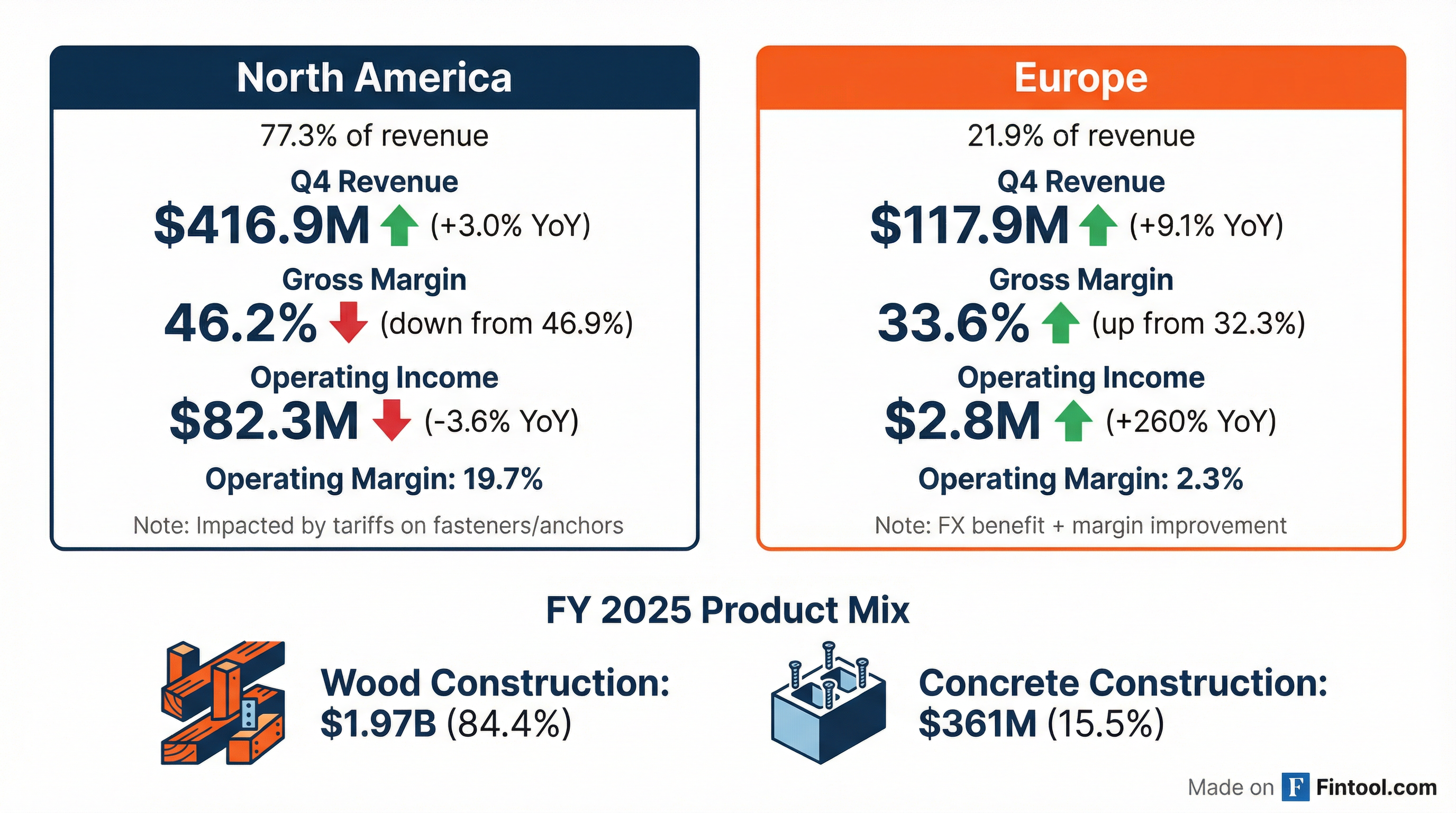
North America (77.3% of Q4 revenue)
Headwinds: Tariffs on imported fastener and anchor products, higher labor and overhead costs, timing of charitable donations and severance costs.
Europe (21.9% of Q4 revenue)
Tailwinds: Favorable EUR/USD exchange rate (~$9.1M benefit), lower material and freight costs, modest volume improvement.
Ask Fintool AI AgentWhat Did Management Guide for 2026?
Management provided initial 2026 outlook with confidence in continued execution:
Important note: The operating margin guidance includes a projected $10-12M gain on the sale of vacant land.
The company continues targeting:
- Above-market volume growth vs. U.S. housing starts
- Operating margin of >20% over time
- EPS growth ahead of revenue growth
What Changed From Last Quarter?
Margin pressure in Q4: Operating margin compressed to 13.9% in Q4 (vs. 19.6% FY) due to:
- Seasonal factors (Q4 typically weaker)
- Timing of charitable donations (accelerated before 2026 tax changes)
- Severance costs related to workforce optimization (~$8M for full year)
- Tariff impacts on imported fastener/anchor products
Cost savings taking hold: The $30M annualized cost savings initiative is structured as roughly 2/3 OpEx benefit and 1/3 COGS. Q4 saw some savings but offset by one-time severance; full benefits flow through in 2026.
Capital allocation ramped up: The company repurchased $120M of stock in 2025. The new $150M authorization for 2026 reflects "confidence in the long-term prospects of the business and our commitment to returning capital to shareholders."
Balance sheet strengthened:
- Cash: $384M (up from $239M YoY)
- Total debt: $374M
- Net cash position: +$10M
- New 5-year $900M credit facility secured in December
Capital Return Track Record
Simpson has returned ~50% of free cash flow to shareholders since 2021, exceeding its 35% target:
Dividend: Board declared $0.29/share quarterly dividend, payable April 23, 2026. This represents the 12th consecutive annual dividend increase.
Q&A Highlights: What Analysts Asked
The earnings call Q&A revealed important context on management's outlook and execution:
On housing market assumptions:
"The last couple of years, the housing market forecasts have started pretty optimistically and ended flat to down... We're really taking a conservative view on the market this year. Our assumptions are basically flat-ish, and we're going to be pretty careful about how we invest until we really see the market pick up significantly." — Mike Olosky, CEO
On regional mix headwinds:
"If you look at California and Florida markets... over the last couple of years have been down significantly. We believe we've got probably 10x the content in those houses that we would in something in the middle of the U.S. So when those markets slow down appreciably, that gives a pretty big headwind." — Mike Olosky
On 2026 operating expenses: CFO Matt Dunn confirmed absolute OpEx dollars expected to be down $10-15 million vs. 2025, even accounting for ~$5M FX headwind. The $30M cost savings initiative is now fully implemented and flowing through.
On steel costs:
"We're buying 150+ different flavors, so there's not a direct correlation to some of the stuff that you see in the market. We also use spot buys... not expecting any impact on our gross margin based on what we know now." — Mike Olosky
On Europe's path to profitability: Management is targeting 15% operating margin in Europe over the midterm, up from 2.3% today. Focus is on existing markets, products, and customers rather than geographic expansion.
End Market Performance: Mixed But Outperforming
The transcript provided granular detail on 2025 performance across business lines:
Key strategic win: CS Producer, a new cloud-based truss production management software, extends Simpson's capabilities "beyond design into production planning and daily operations."
Key Risks and Concerns
Housing market uncertainty: U.S. housing starts remain stuck near 1.4 million — well below the 1.5-1.6M level needed for meaningful volume growth. Census data for 2025 was delayed due to government shutdown.
Regional concentration risk: California and Florida — where Simpson has ~10x revenue content per home vs. central U.S. — have been down significantly. Management expects this headwind to persist in the near term.
Tariff exposure: Management noted tariffs on imported fastener and anchor products negatively impacted gross margins. Concrete products (+15.3% Q4 sales) were particularly affected due to higher import content.
Seasonal Q4 weakness: Q4 operating margin of 13.9% was significantly below the 19.6% full-year margin, reflecting typical seasonality and one-time costs including charitable donations and severance.
Europe profitability: While improving, Europe operating margin remains at just 2.3% (vs. 19.7% in North America), with a long road to the 15% midterm target.
Ask Fintool AI AgentThe Bottom Line
Simpson Manufacturing delivered a solid Q4 with another double beat, capping a strong FY 2025 despite a flat housing market. The company's pricing power, operational discipline, and capital allocation strategy continue to drive outperformance. Management's conservative "flat-ish" housing outlook and careful investment posture suggest they've learned from two years of over-optimistic forecasts.
With the stock near all-time highs and management guiding to 19.5-20.5% operating margins in 2026, investors are paying a premium for a defensive-growth story that has consistently outperformed. The key question: can Simpson continue to grow above-market when their highest-content regions (California, Florida) remain under pressure?
Bull case: Proven ability to grow 300bps above housing starts since 2020, strong balance sheet ($10M net cash), 5-quarter EPS beat streak, $30M cost savings flowing through in 2026, and operating leverage when housing eventually recovers.
Bear case: Premium valuation, 10x regional concentration risk in weak markets (CA/FL), tariff headwinds on imported fasteners/anchors, and continued housing market stagnation could limit upside. Europe remains a long-term project at 2.3% operating margin vs. 15% target.
Related: